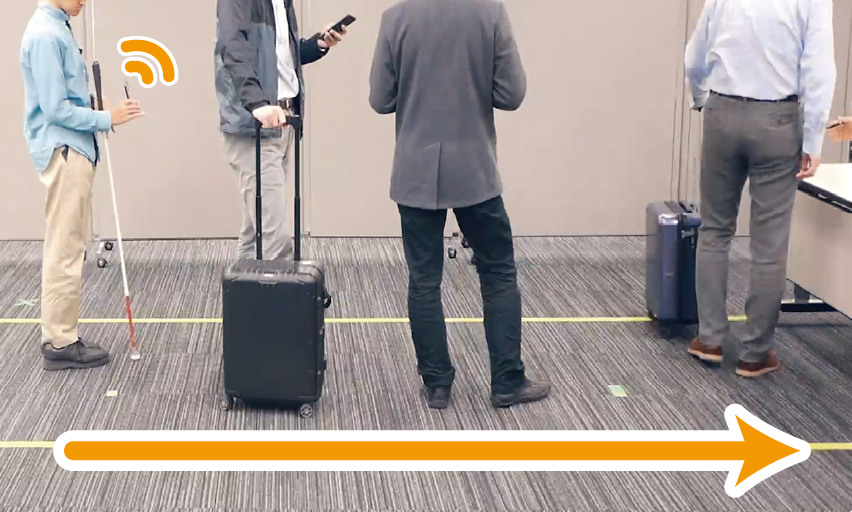
Participants use a smartphone while joining and moving through a queue with other travelers and luggage. The footage includes participants using white canes and a participant accompanied by a guide dog.
We present an assistive system, LineChaser, that helps blind people stand in lines in public spaces by using only off-the-shelf smartphones.
We present an assistive system, LineChaser, that helps blind people stand in lines in public spaces by using only off-the-shelf smartphones.
LineChaser first localizes the user and guides them to the queue entrance. The smartphone camera and depth sensor detect pedestrians and distinguish people waiting in the line from nearby bystanders to locate the end of the queue.
Phase1:
LineChaser determines whether nearby pedestrians are standing in line or not and navigates the blind user to the end of a line.
LineChaser detects and tracks the last person in the queue. As that person advances and turns along the queue, the system guides the user to remain correctly positioned behind them.
LineChaser detects and tracks the last person in the queue. As that person advances and turns along the queue, the system guides the user to remain correctly positioned behind them.
Phase1:
LineChaser determines whether nearby pedestrians are standing in line or not and navigates the blind user to the end of a line.
Phase2:
LineChaser tracks the last person of the line and guides users to stay correctly positioned by using audio and vibration signals.
30-sec Preview Video
LineChaser uses smartphone sensing to find the end of a queue and guide a blind traveler as the line moves.
Main Video [1:16]
LineChaser uses smartphone sensing to find the end of a queue and guide a blind traveler as the line moves.
Presentation Video
LineChaser uses smartphone sensing to find the end of a queue and guide a blind traveler as the line moves.
Abstract
Standing in line is one of the most common social behaviors in public spaces but can be challenging for blind people. We propose an assistive system named LineChaser, which navigates a blind user to the end of a line and continuously reports the distance and direction to the last person in the line so that they can be followed. LineChaser uses the RGB camera in a smartphone to detect nearby pedestrians, and the built-in infrared depth sensor to estimate their position. Via pedestrian position estimations, LineChaser determines whether nearby pedestrians are standing in line, and uses audio and vibration signals to notify the user when they should start/stop moving forward. In this way, users can stay correctly positioned while maintaining social distance. We have conducted a usability study with 12 blind participants. LineChaser allowed blind participants to successfully navigate lines, significantly increasing their confidence in standing in lines.
Publication
Masaki Kuribayashi*, Seita Kayukawa*, Hironobu Takagi, Chieko Asakawa, and Shigeo Morishima (* - equal contribution).2021.LineChaser: A Smartphone-Based Navigation System for Blind People to Stand in Line.In Proceedings of the 2021 CHI Conference on Human Factors in Computing Systems (CHI 2021).
We would like to thank all participants who took part in our user study. We would also thank João Guerreiro, Asuka Hirata, and Yoshiki Kubotani for their support. This work was supported by JST-Mirai Program (JPMJMI19B2), JSPS KAKENHI (JP20J23018), and Grant-in-Aid for Young Scientists (Early Bird, Waseda Research Institute for Science and Engineering, BD070Z003100).