How Users, Facility Managers, and Bystanders Perceive and Accept a Navigation Robot for Visually Impaired People in Public Buildings
Seita Kayukawa, Daisuke Sato, Masayuki Murata, Tatsuya Ishihara, Akihiro Kosugi, Hironobu Takagi, Shigeo Morishima, and Chieko Asakawa

Focus Groups with 12 Blind People

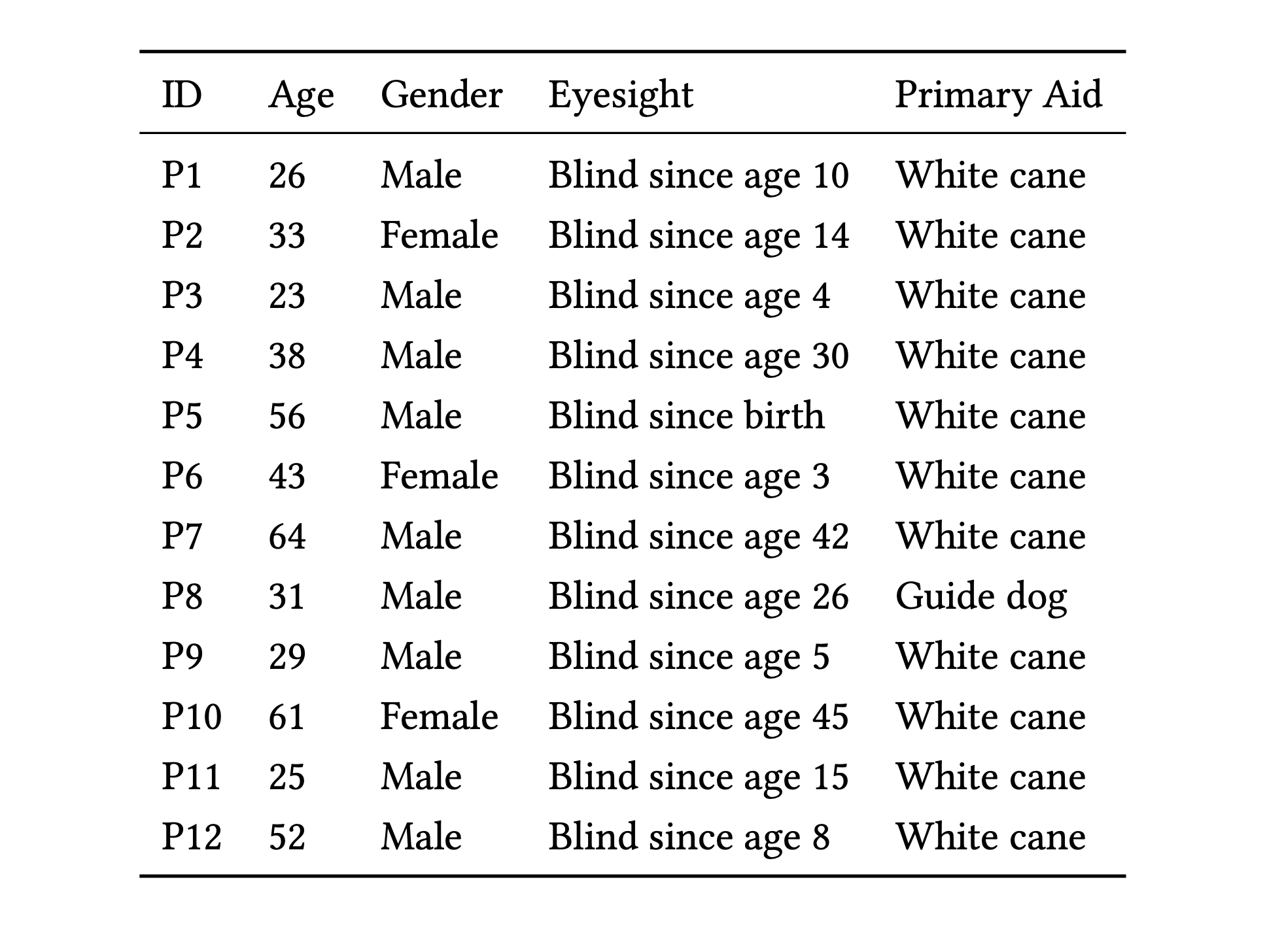
In this study, we asked 12 blind participants to use our robot in an office building and then discussed how to widely adopt autonomous navigation robots in the real world.

Focus Groups with 12 Blind People

In this study, we asked 12 blind participants to use our robot in an office building and then discussed how to widely adopt autonomous navigation robots in the real world.

Floor Map

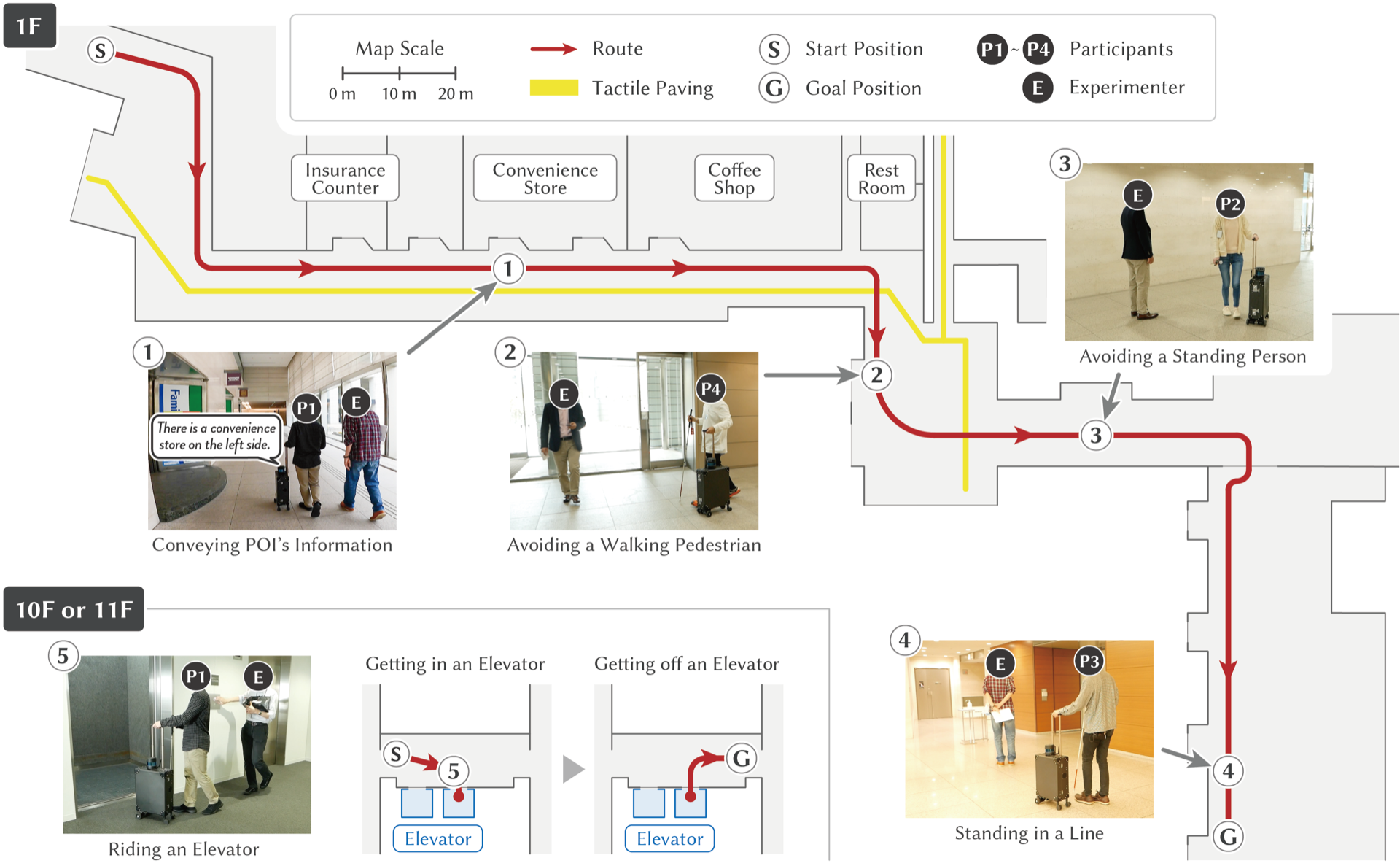
Map of the approximately 160-meter evaluation route from start to goal. Five marked scenarios involve receiving information about a point of interest, avoiding a walking pedestrian, avoiding a standing person, waiting in line, and taking an elevator.
The route used in the focus group with blind people. 1F: We first asked participants to walk along the route (approximately 160 m) on the first floor. The route included points where (1) the robot conveyed information on POIs, (2) an experimenter crossed the participants' route, (3) an experimenter blocked the route, and (4) participants stood in a line. 10F or 11F: We then asked participants to move from a floor to another floor by riding an elevator with the robot (5).

Supplementary Materials